How to Read the Five Elements
A practical guide to using the Five Elements as a starting point for browsing Stillwood Atelier pieces by mood, material character, and daily intention.
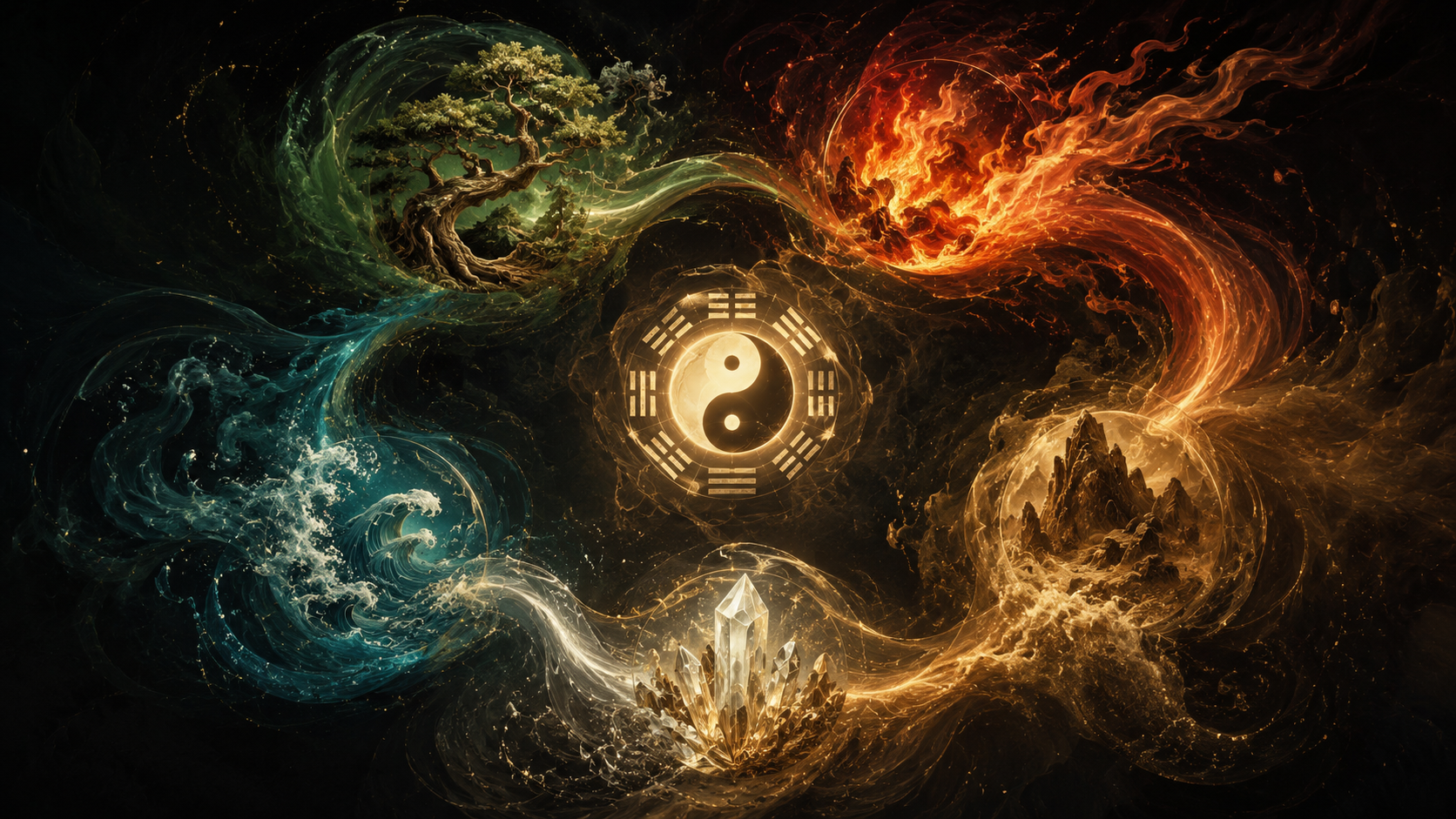
The Five Elements can be used as a way to read the Stillwood Atelier collection. They are not a fixed rule, and they are not meant to place people or objects into simple categories. Instead, they help you understand the mood, material character, and possible daily context of a piece more clearly.
If “What the Five Elements Mean” explains the basic meaning of Wood, Fire, Earth, Metal, and Water, this article focuses on how to use the elements when browsing and choosing pieces.
Do not begin by asking which element you are
When people first encounter the Five Elements, they often ask, “Which element am I?” At Stillwood Atelier, this is not the most important question.
We suggest beginning with a different question: what kind of state do I need right now? What kind of reminder do I want to bring into daily life? What kind of stage do I want this piece to accompany?
A person does not belong to only one element forever. In different stages, relationships, and living conditions, you may be drawn to different elements. Today you may need the stability of Earth. Later, you may need the growth of Wood or the clarity of Metal.
So rather than treating the elements as fixed identities, treat them as a way to observe your current state.
Begin with your current state
If your life has recently felt scattered and you want more steadiness, you may begin with Earth. Earth is often connected with support, grounding, foundation, and reliability.
If you are entering a new stage, starting again, building slowly, or restoring your rhythm, you may begin with Wood. Wood is closer to growth, renewal, flexibility, and long-term development.
If you want more action, expression, warmth, or movement, you may begin with Fire. Fire feels brighter and more visible.
If you need clearer boundaries, stronger judgment, and less unnecessary energy loss, you may begin with Metal. Metal is suitable when you need order, clarity, focus, and structure.
If you are facing change and need more adaptability, patience, and inner steadiness, you may begin with Water. Water is softer and often suitable for transitions and periods of adjustment.
Begin with material and visual feeling
Sometimes you may not know what you need, but you may feel drawn to a certain material, color, or image. This is also a good starting point.
Natural grain, wood-like texture, green tones, or a sense of growth may feel closer to Wood. Bright, warm, energetic colors and structures may feel closer to Fire. Substantial, quiet, grounded materials may feel closer to Earth.
Clean lines, metallic details, cooler tones, and structured designs may feel closer to Metal. Soft sheen, flowing lines, deeper colors, and water-like materials may feel closer to Water.
These are not absolute rules. They are simply a language for describing intuition. You can trust your first visual response, then use the elements to understand why something attracts you.
Work backward from intention
Stillwood Atelier also organizes pieces through intentions such as balance, protection, growth, relationship, career, study, health, or new opportunity.
You can begin with intention and then understand the possible elemental direction behind it.
For example, growth often connects with Wood. Expression, action, and warmth may lean toward Fire. Stability, support, and balance may lean toward Earth. Clarity, boundaries, and focus may lean toward Metal. Adaptability, flow, and inner steadiness may lean toward Water.
However, intention and element are not fixed one-to-one pairs. A protection piece may express stability through Earth, or boundaries through Metal. A growth piece may lean toward Wood, but may also carry the softness and adaptability of Water.
This is why we recommend treating the Five Elements as a reading method, not a formula.
How to browse with the Five Elements
If you do not know where to begin, choose one element and browse from there. Do not rush to purchase. Notice which pieces make you pause.
You can ask yourself:
Does this piece feel quiet, bright, grounded, clear, or flowing? Does it suit my current state, or does it feel better as a gift? Am I drawn to its color, material, meaning, or wearing context? Can it naturally enter my daily life, rather than only feeling meaningful at the moment of purchase?
These questions make selection clearer and help reduce impulse decisions.
Using the Five Elements for gifting
When choosing a gift, the Five Elements can help make your intention more specific.
For someone beginning a new stage, Wood may express growth, renewal, and continuing forward. For someone under pressure, Earth may express stability, support, and grounding. For someone needing courage and action, Fire may feel suitable. For someone needing focus, decision-making, and boundaries, Metal may be appropriate. For someone going through change, study, or adjustment, Water may offer a softer direction.
You do not need to write a long explanation. A simple sentence is enough:
“May this accompany you into a new stage.” “May you keep steady even in busy days.” “May it remind you to choose clearly for yourself.”
The value of the Five Elements in gifting is not to make the gift mystical, but to make your intention easier to understand.
You do not need to be completely correct
Choosing a piece is not an exam. There is no single correct answer. The Five Elements are here to help organize feeling, not to decide for you.
If you feel drawn to a piece but its element is different from what you expected, that is fine. You can trust your own taste, touch, and daily needs.
Sometimes the piece that suits you is not the result of perfect analysis, but the one that makes you feel, “This can accompany me for a while.”
Summary
Reading through the Five Elements is not about fixing people into categories or making objects mystical. It is a gentle browsing method that helps you understand a piece through current state, material feeling, intention, and gifting relationship.
At Stillwood Atelier, the Five Elements are not the answer. They are an entry point. You can begin from them, find pieces that feel more suitable, and return to them differently at different stages of life.