What the Five Elements Mean
A simple guide to how Wood, Fire, Earth, Metal, and Water are used on Stillwood Atelier as a way to understand mood, material feeling, and selection direction.
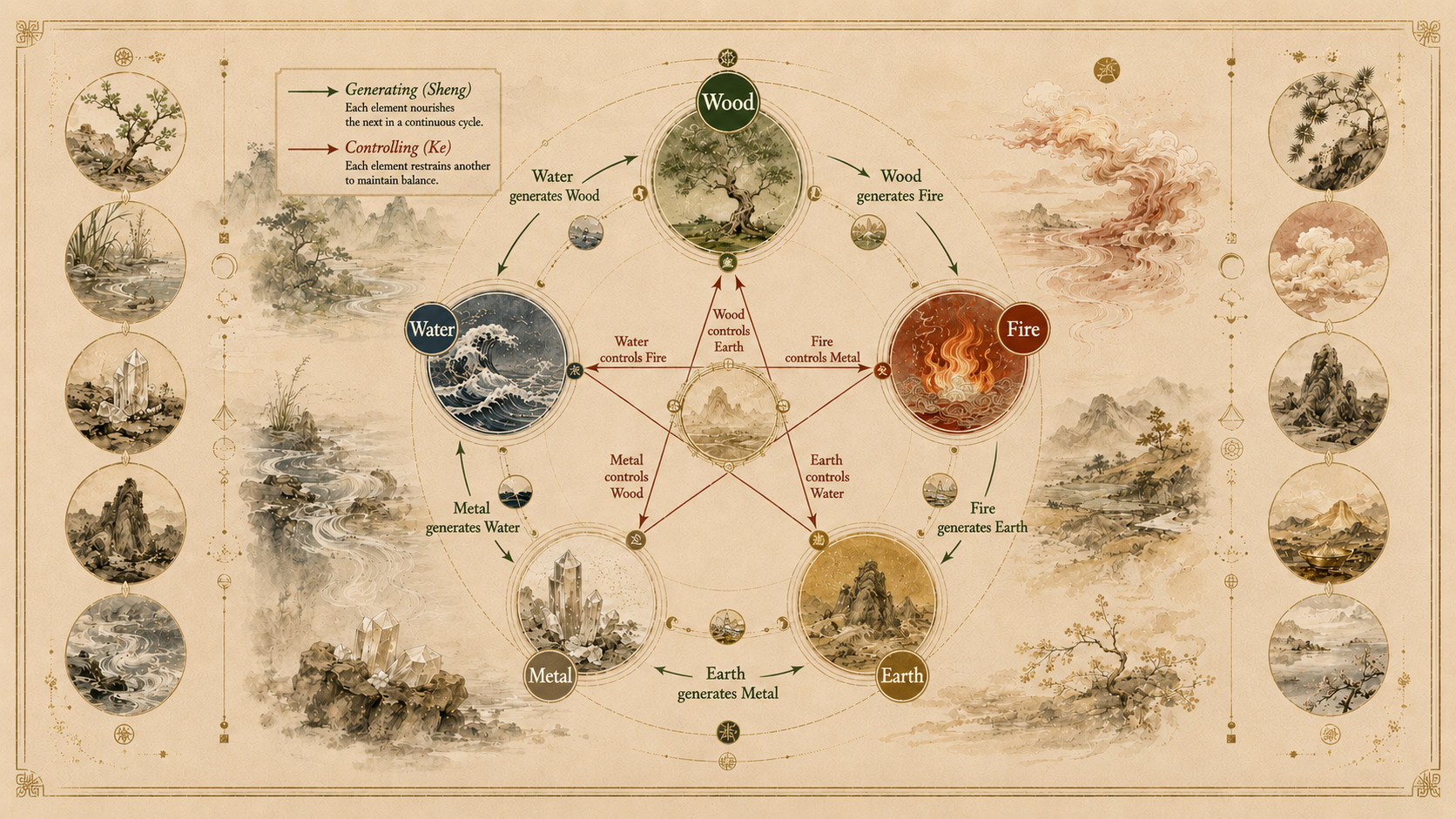
At Stillwood Atelier, the Five Elements are not used as strict rules or promises of outcome. We use them as a way to organize feeling, material character, and selection direction. They help you choose not only by color, style, or price, but also by the mood, rhythm, and everyday meaning behind a piece.
The Five Elements are Wood, Fire, Earth, Metal, and Water. They are not isolated labels. They form a symbolic language for understanding change, state, and tendency. Within Stillwood Atelier, they work as a quiet framework that helps you begin from your current state and move toward pieces that feel more aligned.
The generating cycle
In the traditional understanding of the Five Elements, Wood, Fire, Earth, Metal, and Water are not static categories. They are connected through movement, support, transformation, and balance. Two of the most important relationships are the generating cycle and the controlling cycle.
The generating cycle can be understood as a relationship of support and nourishment. Traditionally, Wood generates Fire, Fire generates Earth, Earth generates Metal, Metal generates Water, and Water generates Wood.
Wood generates Fire because wood can feed flame and allow fire to continue. Fire generates Earth because what burns eventually returns to ash and soil. Earth generates Metal because minerals and ores are found within the earth. Metal generates Water can be understood symbolically through condensation, coldness, and the traditional association between metal and water. Water generates Wood because water nourishes plants and allows growth.
In everyday selection, the generating cycle can be understood as a way to ask: what state do I want to support? If someone is beginning again, they may be drawn to the growth of Wood, but they may also need the nourishment of Water. If someone wants more expression and movement, the relationship from Wood to Fire can help describe that sense of support and ignition.
At Stillwood Atelier, these relationships are not used as absolute judgments. They help create a more nuanced way to understand the connection between pieces, materials, and moods.
The controlling cycle
The controlling cycle is not simply negative. It does not have to mean conflict or suppression. It can be understood as a relationship of regulation, restraint, and balance.
In the traditional cycle, Wood controls Earth, Earth controls Water, Water controls Fire, Fire controls Metal, and Metal controls Wood.
Wood controls Earth because roots enter and shape the soil. Earth controls Water because soil can absorb, block, or redirect water. Water controls Fire because water can reduce flame. Fire controls Metal because heat can melt metal. Metal controls Wood because metal tools can cut or shape wood.
The point of this relationship is not to decide which element is stronger. It is to understand how an excessive state may be moderated. If Fire is too strong, it may suggest too much urgency, consumption, outward energy, or difficulty slowing down. In that case, Water can symbolically help bring coolness, flow, and inner steadiness.
Likewise, if Water feels too heavy, it may suggest hesitation, diffusion, or lack of movement. Fire can then be understood as warmth and activation. The meaning of the Five Elements is not that more of one element is always better. The key is to find a more suitable balance for the present moment.
Why balance matters
Balance is central to the Five Elements. If one element feels weak, it may need support. If one element feels excessive, it may need regulation. Balance does not mean that all five elements must be evenly distributed. It means the overall relationship feels smoother and more appropriate for the current state.
For example, if someone feels rushed, overheated, restless, or emotionally easily triggered, they may describe this as a state of excessive Fire. Instead of choosing more intense, stimulating, or outward-facing symbols, they may feel closer to Water or Earth: Water for calmness and flow, Earth for grounding and support.
If someone feels stuck, passive, or unable to act, Fire or Wood may be more relevant. Fire brings action and visibility. Wood brings growth and renewal.
This is not a medical judgment or a fixed metaphysical conclusion. It is a cultural way of understanding state and direction: using the language of the Five Elements to describe what you are experiencing, and then choosing a piece that can serve as a daily reminder.
How to use generating and controlling relationships in selection
When choosing a piece, you can use the relationships between elements in two ways.
The first is support. If you feel that you lack a certain state, you may choose the element related to that quality. If you want more stability, look toward Earth. If you want more clarity, look toward Metal. If you want more action, look toward Fire.
The second is regulation. If you feel that a certain state is too strong, you may choose an element that helps bring balance. If Fire feels excessive, Water or Earth may offer coolness, softness, and grounding. If Water feels too heavy, Fire or Wood may offer warmth, action, and growth. If Metal feels too strong, Water or Wood may bring more softness and movement.
Stillwood Atelier does not tell customers that they must wear a certain element. Instead, we hope the generating and controlling relationships help people understand whether they are looking for support, strengthening, moderation, or a return to rhythm.
The Five Elements and natural order
The Five Elements are deeply connected with Eastern traditional thought, Daoist culture, and ancient ways of observing nature. They do not describe the world as fixed categories. They observe how things grow, transform, regulate, and cycle.
Wood, Fire, Earth, Metal, and Water can be connected with seasons, directions, colors, temperaments, bodily feelings, and life states. Together, they form a dynamic way of understanding experience: no single force is always best, and no single state should be strengthened without limit.
This is why Stillwood Atelier uses the Five Elements with restraint. We value them as a cultural language and aesthetic structure, not as an exaggerated mystical promise. They help us understand material, meaning, and selection, while reminding us to return to balance, moderation, and natural movement.
Why we use the Five Elements
When people choose jewelry, gifting pieces, or small objects, they are often not only looking for something beautiful. They may be looking for a reminder, a companion, a way to express a state, or a meaningful gift for someone else.
The Five Elements help make these feelings clearer. If you want steadiness, you may begin with Earth. If you want clarity, you may begin with Metal. If you want action and expression, you may begin with Fire. If you want renewal and growth, you may begin with Wood. If you want flow, adaptability, and inner steadiness, you may begin with Water.
They do not tell you what you must choose. They simply offer a calmer and more directional starting point.
Wood: growth and renewal
Wood is associated with growth, renewal, flexibility, and steady development. It suits those who are entering a new stage, rebuilding rhythm, recovering energy, or wanting life to feel more alive again.
The quality of Wood is not a sudden burst. It is a steady upward movement. Like a tree, it asks for time, space, and patience. When choosing a Wood-related piece, you can understand it as a quiet reminder: not every change needs to happen at once, but you can continue moving forward.
In daily wear, Wood is suitable for beginning new habits, restoring rhythm, building long-term plans, or gifting someone who is starting again.
Fire: expression and action
Fire is associated with expression, warmth, visibility, and action. It suits those who want to be more active, more present, or more willing to express and move things forward.
The quality of Fire is bright and outward-facing. It does not have to mean impulsiveness. It can mean allowing inner thoughts to be seen and bringing movement back into a still state.
When choosing a Fire-related piece, you can treat it as a reminder of action: speak the idea, take one step forward, and bring warmth back into daily life.
Earth: stability and support
Earth is associated with grounding, stability, trust, and support. It suits those who want life to feel steadier, more practical, or more supported.
The quality of Earth works well for daily wear because it is not loud or urgent. It feels like a quiet foundation, bringing attention back to reality, the body, and the present moment.
When choosing an Earth-related piece, you can understand it as a reminder to slow down, stand steadily, and rebuild the foundation. It is also suitable as a gift for someone under pressure, in transition, or in need of support.
Metal: order and clarity
Metal is associated with order, clarity, boundaries, judgment, and refinement. It suits those who want more focus, better structure, or clearer decisions.
The quality of Metal is not only cold or hard. It can also mean clean, precise, and well-measured. It helps reduce confusion and return to clearer judgment.
When choosing a Metal-related piece, you can treat it as a reminder to see what matters, define boundaries, and reduce unnecessary noise. It is suitable for work, decision-making, self-discipline, and moments when you want to feel more clear-minded.
Water: flow and wisdom
Water is associated with flow, wisdom, adaptability, and inner steadiness. It suits those who are facing change, adjusting their rhythm, or wanting to move through life with more softness and flexibility.
The strength of Water is not confrontation. It is movement, patience, and continuity. It can be quiet, and it can be deep. When choosing a Water-related piece, you can understand it as a reminder that you do not need to control everything in order to keep your direction.
Water is also suitable as a gift for someone in transition, learning, emotional adjustment, or a period that requires more patience and space.
The Five Elements are not fixed labels
When browsing by element, you do not need to treat it as a fixed label. A person does not belong to only one element, and a piece does not need to express only one meaning.
Sometimes you may be drawn to a material. Sometimes it is a color, motif, or wearing situation that feels right. The Five Elements are simply one way to understand that attraction.
You can begin with the elements, or you can begin with intention, material, gifting relationship, or occasion. What matters most is whether the piece can naturally enter your life, feel suitable for you, or feel suitable for the person you are gifting.
How to choose through the Five Elements
If you do not know where to begin, ask yourself a few questions:
Do I need more stability, growth, expression, clarity, or adaptability right now? What do I want this piece to remind me of? Where and when will I wear it? Is it for myself or for someone else? Do I care more about symbolism, material, or everyday styling?
There are no standard answers. These questions simply help you move closer to a choice that feels more personal and appropriate.
Summary
At Stillwood Atelier, the Five Elements are a language of selection and a way to understand our pieces. They do not promise results, and they do not replace your own judgment. They simply connect feeling, material, symbolism, and daily wear.
When choosing a piece, you do not need to find the one absolutely correct answer. If it connects with you at a certain stage, and can be worn, used, or remembered naturally, it already carries meaning of its own.